

 News
News Industry News
 With the implementation of dual-carbon policies and the normalization of environmental supervision, industries such as thermal power, metallurgy, chemical, and pharmaceutical have continuously upgraded their requirements for the accuracy, stability, and anti-interference capabilities of online monitoring of sulfur dioxide (SO₂) emissions. Traditional semiconductor SO₂ sensors generally suffer from pain points such as large zero-point drift, severe cross-interference, and inaccurate measurement range. The MQ-E3-SO₂ sulfur dioxide sensor based on the constant potential electrolysis principle, relying on electrochemical oxidation-reduction core technology, has become a core sensing element for online monitoring of industrial environmental emissions, plant safety early warning, and flue gas CEMS due to its advantages of high precision, low power consumption, and strong anti-interference.
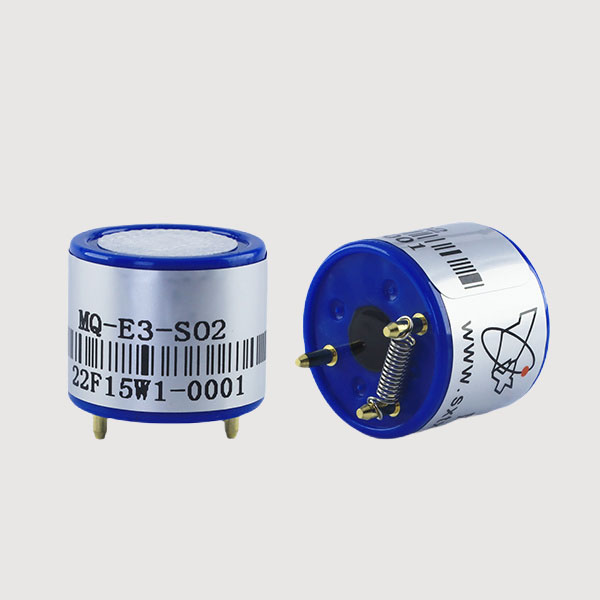
Constant Potential Electrolysis Principle: Strengthening Core Detection Advantages from the Root
MQ-E3-SO₂ employs a constant potential electrolysis electrochemical detection structure. Sulfur dioxide and oxygen undergo a directional oxidation-reduction reaction at the working and counter electrodes. The generated induced current is precisely proportional to the SO₂ gas concentration. By collecting weak current values and converting them into gas concentration, it offers significant advantages in the field of trace SO₂ detection compared to infrared and semiconductor sensing solutions:
Linear Output, Precise and Controllable Measurement: The factory-calibrated sensitivity is (0.55±0.15)μA/ppm, with a standard range of 0~20ppm and a limiting measurement value of up to 150ppm. It maintains linear output across the entire range, achieving a resolution of 0.1ppm. It can accurately capture trace leaks in factory areas and fluctuations in trace SO₂ emissions in ultra-low emissions, meeting national environmental protection requirements for trace detection.
Rapid response, timely safety warnings: The T90 response time is <30 seconds. Upon gas contact with the sensing membrane, it quickly generates an electrical signal, compatible with fixed online alarms and portable detectors. In the event of a sudden SO₂ leak in the workshop, it can instantly provide concentration feedback, triggering interlocking devices such as exhaust fans and feed valve shut-off to mitigate the risks of poisoning and corrosion of production equipment.
Low drift + long-term stability, reduced calibration frequency: Zero-point drift ≤0.2ppm over a wide temperature range of -20℃ to 40℃, monthly stability drift <2% of output value, repeatability error <2%. Compared to similar products, the monthly calibration frequency is reduced by 60%, significantly lowering the maintenance costs of industrial equipment.
Robust Parameters Enable Stable Operation in Complex Conditions and Across All Temperature and Humidity Environments
Addressing the harsh conditions of industrial sites, including large temperature differences, humidity fluctuations, air pressure changes, and mixed gases, the MQ-E3-SO₂ is adapted to industrial application needs through hardware design and parameter selection:
1. Wide Environmental Tolerance
Operating temperature range: -20℃ to 50℃, ensuring stable operation from low-temperature winter factories in northern regions to high-temperature and humid chemical workshops in southern regions;
Applicable humidity range: 15% to 90% RH, resistant to boiler flue gas condensate and high-humidity environments in wet desulfurization workshops;
Pressure range: Standard Atmospheric Pressure ±10%, suitable for negative pressure flue gas pipelines and positive pressure closed reaction vessel sampling and testing scenarios.
2. Excellent resistance to cross-interference, avoiding false alarms from mixed gases.
Industrial sites often produce byproducts such as CO, H₂S, formaldehyde, ammonia, and benzene compounds. The sensor, with its optimized formula, boasts industry-leading cross-interference control: 200ppm CO interference is equivalent to <2.5ppm SO₂, 50ppm H₂S interference is <0.15ppm, and 100ppm benzene has no output interference. Only formaldehyde presents a slight interference, which can be easily compensated by backend algorithms, reducing false alarms at the hardware level. It is suitable for chemical synthesis, coking, coating, and other plants where multiple mixed gases coexist (see original manufacturer specifications for cross-interference data).
3. Low power consumption and easy integration, adaptable to diverse circuit solutions.
Zero bias (0mV) design, recommended to be matched with a 10Ω load resistor. A low-cost sampling circuit can be built by pairing it with an AD8572 op-amp and an MCP1700 voltage regulator chip. Power supply is 3.3~5.5V, with extremely low power consumption. It can be embedded in 24-hour online fixed monitoring transmitters or used in portable SO₂ leak detectors powered by lithium batteries. The nominal service life in air is 2 years, meeting the normal replacement cycle of industrial equipment, offering outstanding cost-effectiveness.
Industry-Wide Application Scenarios, Covering Two Core Tracks: Industry and Environmental Protection
Leveraging its performance advantages, the MQ-E3-SO₂ is widely applied in two major areas: industrial safety production and environmental exhaust gas monitoring. Specific scenarios are as follows:
Online Monitoring of Environmental Flue Gas (with CEMS)
Emission monitoring of exhaust gases from thermal power plants, waste incineration plants, metallurgical sintering furnaces, coal-fired boilers, and ceramic kilns. Embedded in online flue gas analyzers, it monitors the SO₂ emission concentration at chimney outlets in real time, assisting enterprises in achieving emission standards and connecting to environmental protection platforms for online data upload, meeting the mandatory online monitoring requirements of discharge permits.
Safety Management in Chemical Production
Inspection of enclosed spaces in sulfuric acid manufacturing, fine chemical, pesticide and pharmaceutical, and sulfide synthesis workshops: Fixed probes are deployed in reaction vessels, pipe flanges, and storage tank areas to monitor equipment leaks in real time; portable detectors equipped with sensors allow inspection personnel to detect leaks on-the-go, preventing the accumulation of toxic SO₂ gases and potential poisoning.
Metallurgy and Building Materials Industry
Monitoring of processes in iron and steel smelting, non-ferrous metal roasting, and rotary kiln systems in cement plants; monitoring the emission of SO₂ byproducts from roasting processes; optimizing the operating efficiency of desulfurization units; and reducing the risk of excessive emissions.
Third-Party Environmental Monitoring and Research:
Grid-based deployment of air monitoring stations; laboratory catalytic combustion experiments; and research and development of environmental chemical engineering projects in universities, used for tracing trace amounts of SO₂ in the atmosphere and identifying pollution sources.
MQ-E3-SO₂ perfectly addresses the industry pain points of SO₂ detection—false alarms, large drift, and short lifespan—thanks to its mature constant-potential electrolysis process, high precision and low drift, strong anti-interference capabilities, easy integration, and high cost-effectiveness. As the original manufacturer, Tensensor offers bulk customization, technical circuit guidance, and selection and adaptation services, making it the preferred choice for gas detector manufacturers, environmental equipment manufacturers, and automation integrators seeking SO₂ electrochemical sensors.
Email: [email protected]
WhatsApp: +86 18335818384
 Message
 E-mail
 Whatsapp


